
Australia's House Price "Up-Crash"
In theory, higher interest rates should cool property prices. Borrowing power falls, repayment costs rise and buyers are forced to step back. Yet across many parts of Australia in early 2026, the most intense heat in the market is not at the prestige end ' it's in the very segments that were once considered 'entry level'.
Economists and buyer's agents have started describing this as an 'up-crash': instead of a neat correction, cheaper homes and units are being bid up rapidly as desperate first home buyers and yield-focused investors compete for a limited pool of relatively affordable properties.
Today we unpack what's driving that dynamic, how it shows up in current data and on-the-ground stories, and what it means for first home buyers and small investors trying to navigate the market in 2026.
What do we mean by an 'up-crash'?
The term 'up-crash' captures a counterintuitive reality: price growth is strongest at the lower end of the market, even while broader affordability has worsened and interest rates remain higher than in the ultra-cheap money era of 2020-2024.
Recent reporting has highlighted examples like inner-Brisbane apartments where sales from just a few weeks earlier are already out of date. Open homes attract dozens of groups, with first home buyers, investors and downsizers all competing for the same stock. Even after Reserve Bank rate hikes, many would-be buyers remain more worried about being locked out of the market than about slightly higher repayments.
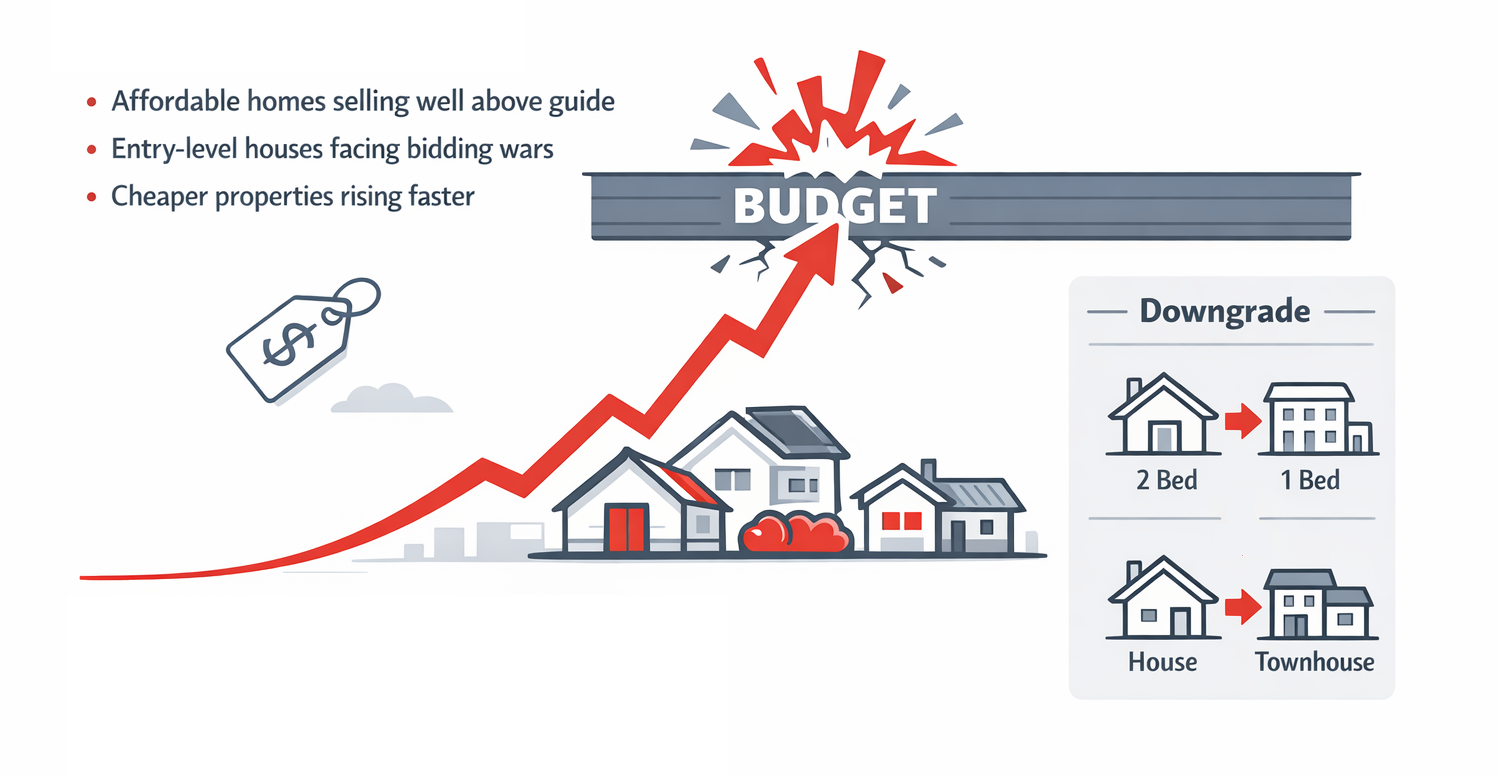
In practical terms, an up-crash looks like:
- Smaller, more affordable units and townhouses selling well above price guides.
- Previously 'entry-level' houses in middle-ring suburbs attracting multiple strong offers.
- Lower quartile values (the cheaper 25% of homes) growing faster than the top quartile in many areas.
- Buyers being forced to downgrade from a two-bedroom to a one-bedroom apartment, or from a freestanding house to a townhouse or duplex, just to stay within budget.
The macro backdrop: rates, inflation and constrained supply
The up-crash is unfolding against a backdrop that would normally favour weaker, not stronger, prices:
- Interest rates are higher than in the early 2020s, meaning borrowing capacity is down and serviceability tests are tougher.
- Inflation has eaten into household budgets, particularly through rents, utilities, insurance and everyday living costs.
- Construction remains under strain, with elevated building costs, capacity constraints and a pipeline of delayed or cancelled projects.
- Population growth has rebounded, driven by migration and natural increase, at the same time as the dwelling pipeline has thinned.
Put simply, fewer new homes are being delivered than Australia needs, especially in the big capitals. When you combine that with robust household formation and a strong preference for established, well-located stock, it's not surprising that competition is fiercest for anything that still looks 'affordable enough'.
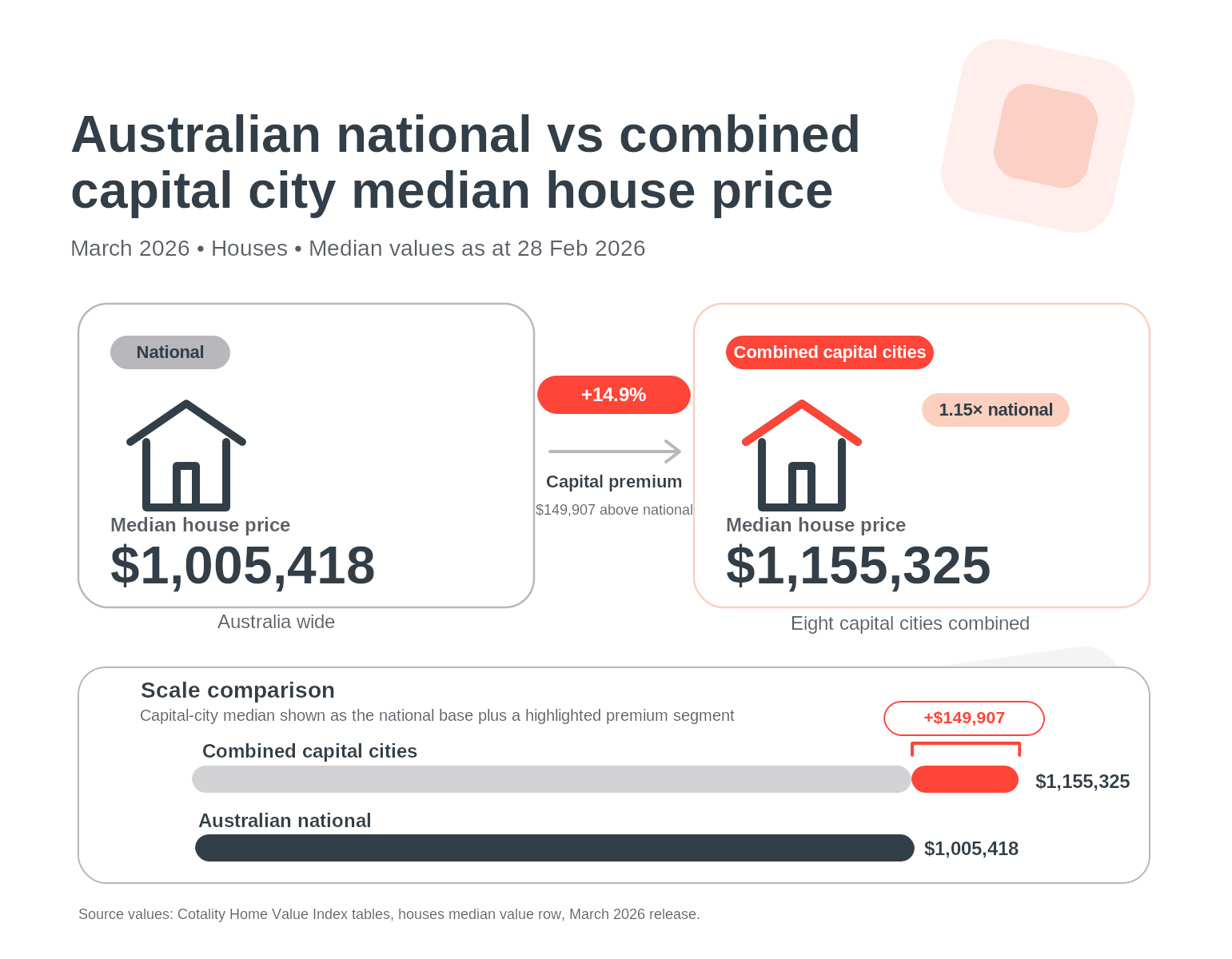
National median house price data compiled by industry analysts suggests values across the country are hovering around the $1 million mark, with capital city medians materially higher again. Even the 'cheaper' end of today's market often means stretching to high-$700k or low-$800k price points in many metro areas.
Evidence of the up-crash at the lower end
While precise figures vary by city and data provider, several consistent themes are emerging in early 2026:
- Lower-priced segments are leading growth. In many markets, the lower quartile of home values has outperformed the upper quartile over the past year, as more buyers crowd into what they can (just) afford.
- Units in good locations are back in favour. Inner- and middle-ring apartments that were out of favour earlier in the decade are seeing renewed interest, particularly where they offer a relative discount to houses but still good access to jobs, transport and lifestyle.
- Smaller capitals and select regional centres are running hot. Cities like Brisbane and Adelaide, along with certain coastal and commuter belts, have seen strong demand for sub-$800k houses and townhouses as buyers are priced out of Sydney and Melbourne.
- Rents are climbing, especially for smaller dwellings. In many capitals, unit rents are growing slightly faster than house rents, reflecting affordability pressures and strong demand for smaller, more affordable dwellings.
On the ground, this shows up as:
- One- and two-bedroom units in well-located suburbs selling quickly, often after highly competitive opens.
- Properties that might have been considered 'starter stock' now attracting interest from seasoned investors looking for robust rental demand and better gross yields.
- Buyers' agents and selling agents reporting that recent comparable sales become 'stale' within weeks in the most competitive pockets.
First home buyers: squeezed but still pushing in
First home buyers (FHBs) are at the centre of the up-crash story. On the one hand, they face some of the toughest conditions in decades:
- Savings hurdles: bigger deposits required as prices rise, with higher rents making it harder to save.
- Borrowing capacity limits: higher rates and serviceability buffers mean many FHBs qualify for smaller loans than they would have a few years ago.
- Cost-of-living pressure: insurance, energy, groceries and childcare costs all bite into surplus cash flow.
, there is a powerful psychological and financial incentive to 'get in before it gets worse':
- Many FHBs worry that if they wait for the perfect moment, prices will have moved even further out of reach.
- Government schemes, guarantees and stamp duty concessions can nudge some into the market sooner than they otherwise would.
- Social pressure and headlines about rising prices reinforce fear-of-missing-out.
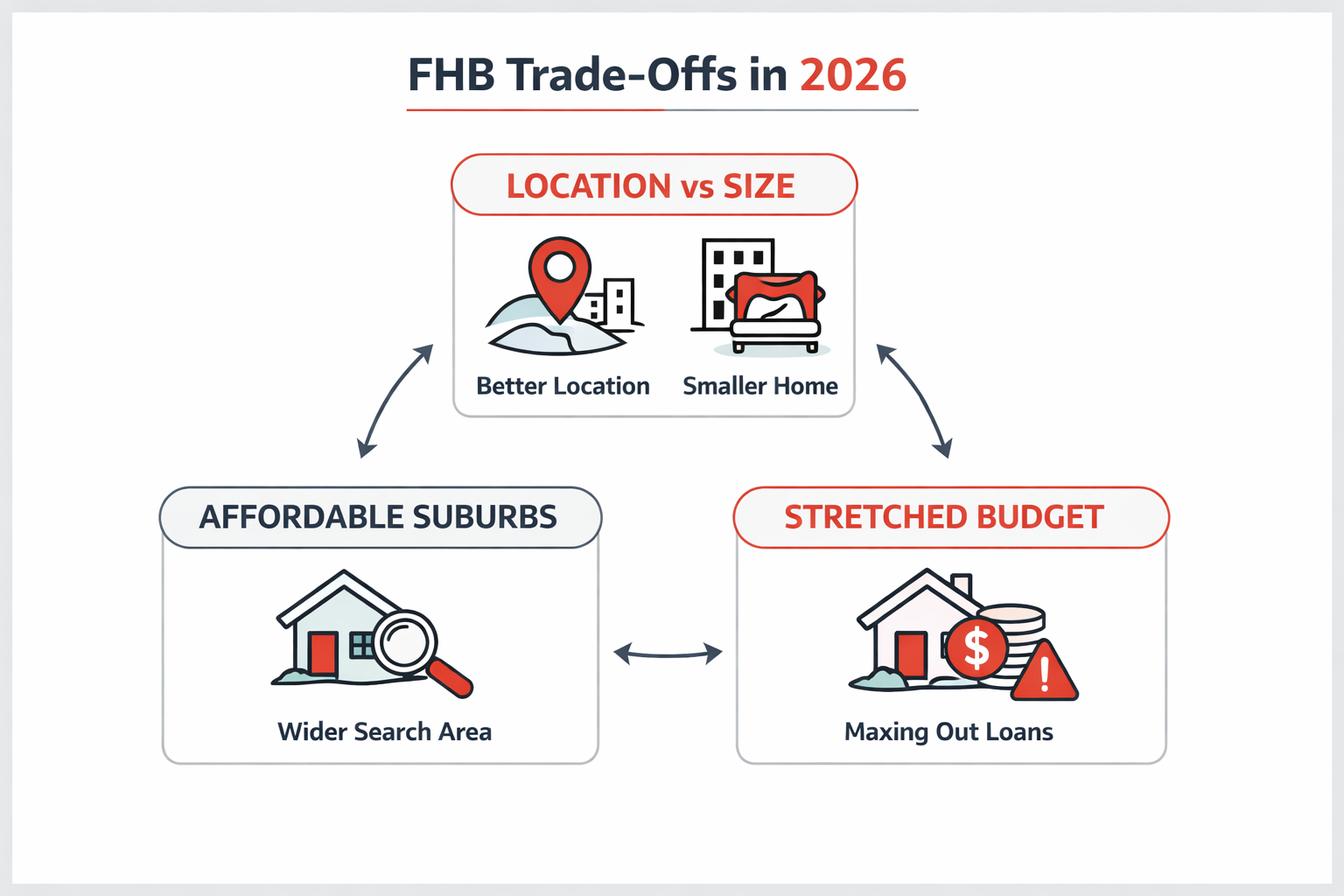
That combination is driving behaviours like:
- Compromising on property type or size ' e.g. choosing a well-located one-bedroom apartment over a larger but more remote option.
- Expanding the search radius to more affordable but still commutable suburbs.
- Stretching budgets to the upper limit of pre-approval, which can leave little buffer if rates rise again or circumstances change.
For many FHBs, the key risk is not just getting into the market, but doing so on a sustainable footing. In an up-crash environment, it's easy to get swept up in competition and overextend.
Investors: chasing yield in the same suburbs
Investors are the other major driver of demand at the affordable end. While higher interest rates have pushed some highly leveraged investors to the sidelines, others see opportunity in:
- Rising rents and tight vacancy rates, particularly for smaller dwellings in high-demand areas.
- Tax settings that still favour property investment, including negative gearing and the capital gains tax discount (notwithstanding periodic policy debate about their future).
- Perceived resilience of well-located, entry-level stock that can appeal to both owner-occupiers and tenants.
In practice, this means:
- Investors bidding on the same one and two bedroom units, townhouses and modest houses that FHBs are targeting.
- Willingness to pay a premium for properties with strong rental appeal, even if short-term cash flow is tight, on the assumption that rents and values will rise further over the medium term.
- More sophisticated investors looking to 'upgrade' their portfolios by selling underperforming assets and recycling capital into higher-yielding, more resilient properties.
When investors and FHBs converge on the same listings, it amplifies the up-crash: more bidders, stronger offers and greater urgency.
Risks and vulnerabilities in an up-crash
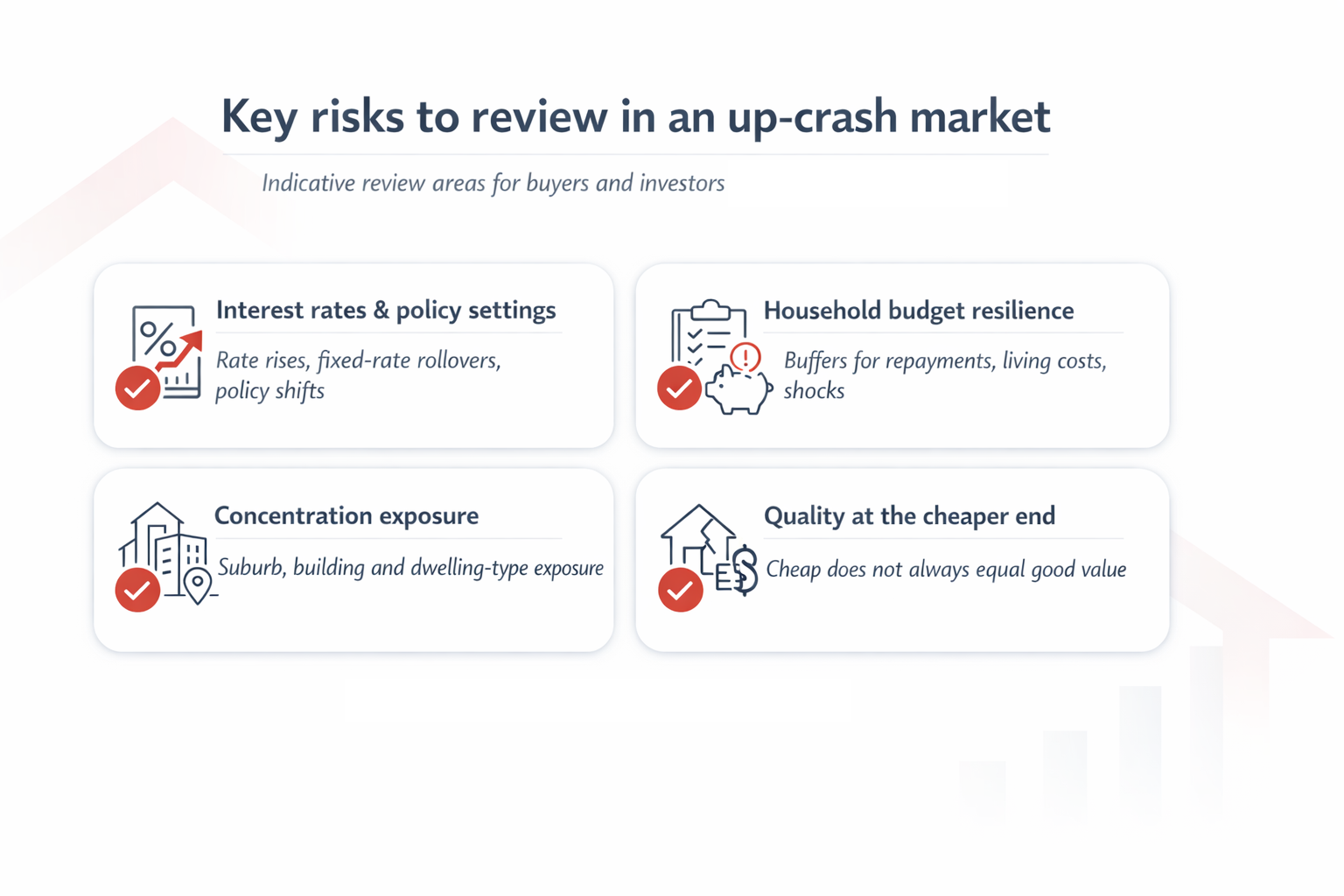
Despite the strong competition and rising prices at the lower end, this is not a risk-free environment. Key vulnerabilities include:
-
Interest rate and policy risk
If inflation proves sticky or global conditions worsen, further rate rises cannot be ruled out. Even without hikes, borrowers rolling off older fixed rates may face higher repayments. Policy changes affecting investor tax settings or lending standards could also shift demand. -
Household budget stress
Buyers who stretch to the limit of their borrowing capacity may find it difficult to absorb shocks such as job loss, illness, or further cost-of-living increases. This is especially true where repayments and non-discretionary expenses already consume most of the household budget. -
Concentration risk
Investors who concentrate too heavily in a small number of suburbs or in a single dwelling type (for example, all inner-city one-bedrooms) may be more exposed if local conditions change or if a future building issue affects a particular complex. -
Quality risk at the cheaper end
Not all 'affordable' properties are created equal. Some cheap stock reflects genuine value; other properties are cheap because of structural issues, poor layouts, problematic owners corporations or location drawbacks that will remain long after this cycle.
For both FHBs and investors, the message is clear: competition and rising prices do not cancel out the need for due diligence and sensible buffers.
Practical guidance for buyers and investors in 2026
If you're looking to buy in this environment, consider the following practical steps.
a) Get your finance foundations right
- Secure a robust pre-approval from a reputable lender or broker before you start seriously inspecting.
- Stress-test your budget at repayment levels well above current interest rates (e.g. +2' percentage points) to make sure you're comfortable.
- Factor in realistic allowances for insurance, utilities, strata fees and maintenance; don't just look at the mortgage repayment.
b) Be strategic about compromise
- Decide up front which trade-offs you're willing to make: property type, size, condition, commute time, school zones, access to transport, and so on.
- Consider whether a slightly smaller or older property in a better-located suburb will serve you better over the long term than a larger dwelling much further out.
- Be cautious about compromising on fundamentals like natural light, major structural issues or severe noise exposure just to 'get in'.
c) Focus on quality and liveability, not just price
- Look for solid building quality, good layouts, and locations with enduring appeal (transport, jobs, services, lifestyle).
- Investigate the building's history, sinking fund and any known defects when buying strata property.
- Arrange independent building and pest inspections for houses and townhouses, and consider a strata report for apartments.
d) For investors: think beyond today's rent
- Model your cash flow carefully, including realistic assumptions about vacancies, maintenance and interest rate scenarios.
- Focus on assets with diversified tenant appeal (young professionals, small families, downsizers), not just the current most enthusiastic segment.
- Avoid overpaying purely on the assumption that rents will continue rising at recent rates indefinitely.
e) Take your time where you can
- In an up-crash, it can feel like every property requires an immediate, aggressive offer. Where possible, slow the process down enough to do proper checks.
- Use each missed opportunity to refine your search criteria and your sense of value in your chosen suburbs.
- Remember that while the overall market may be tight, individual properties can still be mispriced; not every listing will attract 10+ serious buyers.

Conclusion: navigating an uneven market
Australia's 2026 up-crash at the affordable end of the housing market reflects a clash between constrained supply, strong population growth, higher borrowing costs and deep-seated demand for home ownership and residential investment.
For first home buyers and small investors, the challenge is to participate in the market without being steamrolled by it. That means combining realistic expectations and thoughtful compromise with disciplined due diligence and financial buffers.
The lower end of the market may be running hottest today, but that doesn't mean every property is a good buy. Focus on quality, resilience and a time horizon measured in years, not months, and be prepared to walk away from deals that don't stack up ' even when the up-crash noise is loudest.
References & further reading
- National and capital city median price summaries drawing on current CoreLogic/Cotality data (March 2026).
- City-level market updates from established property research and advisory outlets outlining recent trends in values, rents and yields across dwellings and regions.
- Guardian Australia coverage of intense competition at the cheaper end of the market and the emerging 'up-crash'
If you've been seeing this in your local market, you can leave a comment and share your experience on our Educational Hub community post: Australia's 2026 "up-crash": why the lower end of the market is running hottest.


