
5% Deposit Scheme vs Help to Buy: Which First-Home Buyer Scheme Is Better in 2026?

For Australian first-home buyers, the problem in 2026 is not just saving a deposit. It's choosing the least risky path into a market where values are still rising, borrowing costs remain restrictive, and the federal support options now work in very different ways.
That matters because the biggest headline changes landed only recently. The government's expanded 5% Deposit Scheme took effect on 1 October 2025, while Help to Buy opened for applications on 5 December 2025. Both are meant to bring buyers forward, but they remove different barriers. One mainly reduces upfront cost. The other reduces the amount you need to borrow.
If you are comparing the two, the wrong question is not "which scheme is better?" but "which scheme solves my actual constraint?"
The market backdrop is still hard work
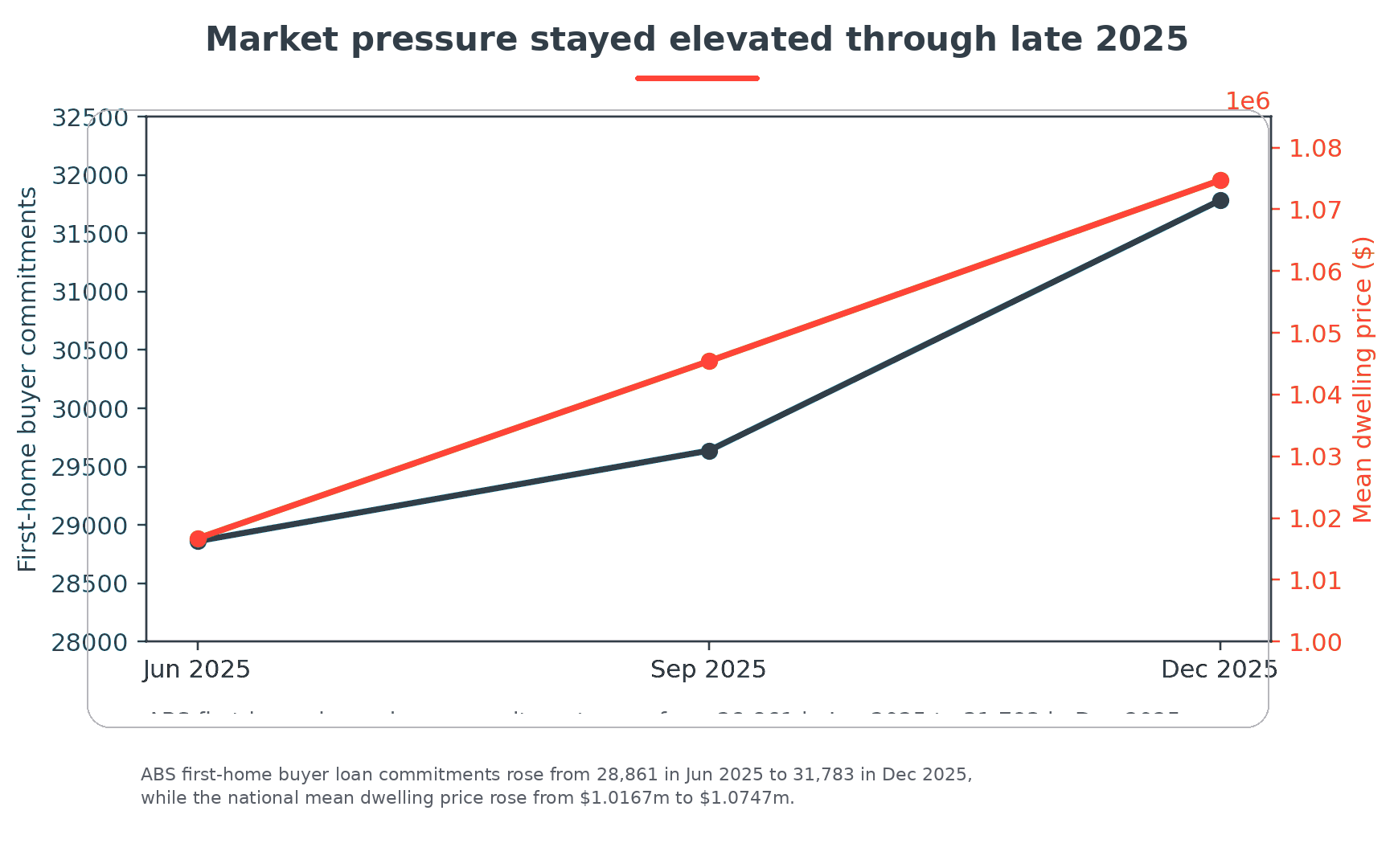
Policy support is arriving into a market that is hardly cheap. ABS data released on 10 March 2026 showed the total value of Australia's residential dwellings reached $12.3072 trillion in the December quarter 2025, with the national mean dwelling price rising to $1,074,700.
At the same time, the RBA cash rate target was set at 3.85% effective 4 February 2026 after a 25 basis point increase. That does not tell you what your mortgage rate will be, but it does tell you that serviceability is still a live issue. Even when buyers can clear the deposit hurdle, lender assessment rates and monthly repayments can still block the purchase.
There are signs that buyers are still pushing in. ABS lending indicators showed new owner-occupier first-home buyer loan commitments rose 6.8% in the December quarter 2025 to 31,783, while the value of those loans jumped 15.5% to $19.3 billion. In plain terms, more first-home buyers borrowed, and they borrowed larger amounts.
What the 5% Deposit Scheme now does
The expanded Australian Government 5% Deposit Scheme is the simpler of the two programs to understand. It is designed for buyers who can service a loan, but have not saved a 20% deposit.
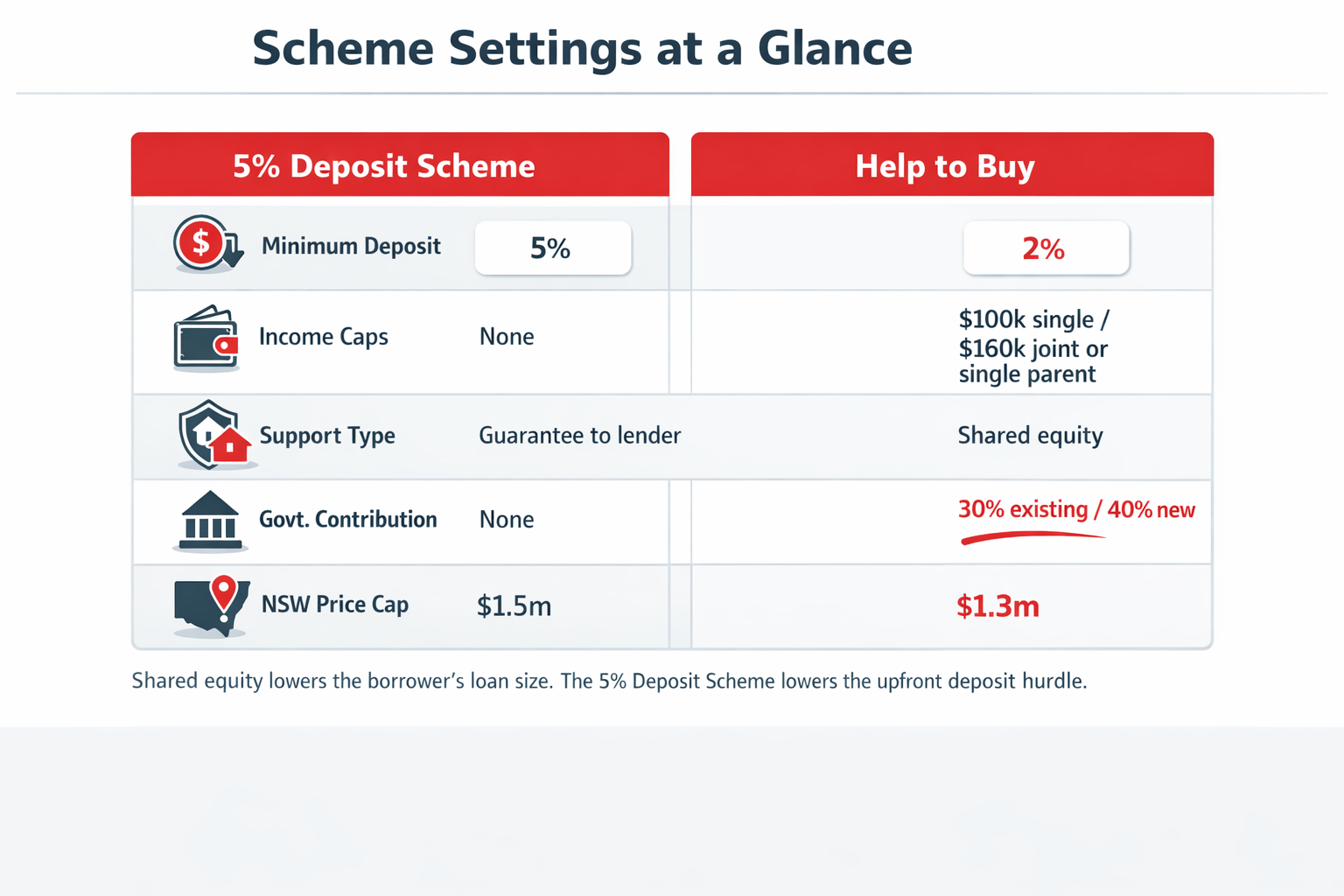
Under the scheme, eligible first-home buyers can purchase with a minimum 5% deposit and avoid lenders mortgage insurance. That can materially reduce the cash needed to get into a home, especially in markets where LMI would otherwise add a painful upfront or capitalised cost.
The major shift from 1 October 2025 was not just branding. Housing Australia says the scheme moved to no place limits, no income caps, higher property price caps and a simpler structure for regional buyers through the main first-home buyer pathway.
That makes the scheme broader than many buyers may remember from earlier versions. It is no longer as tightly rationed, and it no longer shuts buyers out because their income is above an older threshold.
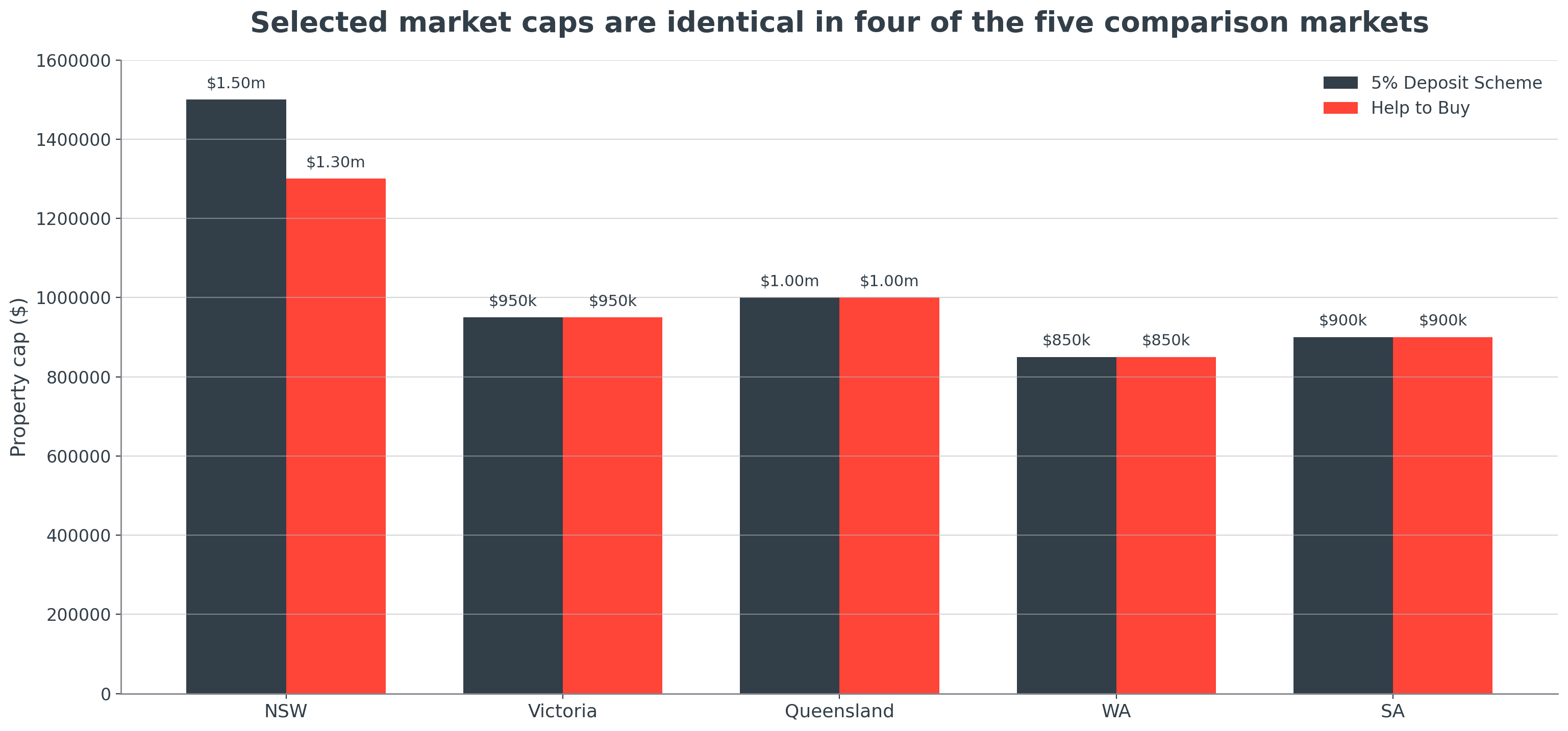
The price caps are also much higher in some markets. On the current First Home Buyers portal, the cap for New South Wales capital cities and regional centres is $1.5 million, compared with $950,000 in Victoria capital cities and regional centres, and $1 million in Queensland capital cities and regional centres. Buyers still need to check the postcode-specific limit with a participating lender, but the practical point is clear: the scheme now reaches more metropolitan stock than before.
How Help to Buy is different
Help to Buy is not a low-deposit guarantee. It is a shared-equity scheme. That distinction matters.
Under Help to Buy, a buyer needs to save at least a 2% deposit and obtain a home loan from a participating lender, while the government contributes up to 30% of the purchase price for an existing home or up to 40% for a newly built home. The immediate benefit is that the buyer can borrow less than they otherwise would for the same property.
That can change the maths dramatically for households that are close on deposit but stretched on serviceability. A smaller loan can mean lower repayments, a lower interest burden and a better chance of passing lender assessments.
But Help to Buy is narrower than the 5% Deposit Scheme. It still has income caps of $100,000 for individual applicants and $160,000 for joint applicants or single parents, based on the previous financial year's notice of assessment. It also has its own property price caps, which are generally lower than the 5% Deposit Scheme caps in the same market.
For example, the Help to Buy cap for New South Wales capital city and regional centre locations is currently $1.3 million, not $1.5 million. In Victoria it is $950,000, in Queensland $1 million, and the official site notes that Tasmania has yet to pass enabling legislation. Buyers also need to be comfortable with the trade-off that the government shares in the property's value, including when it rises.
Which type of buyer each scheme suits
The 5% Deposit Scheme tends to suit buyers who have enough income and borrowing capacity to carry a normal mortgage, but want to avoid the time it would take to save a 20% deposit. For this buyer, the constraint is cash upfront, not necessarily loan size.
Help to Buy tends to suit buyers whose main barrier is the size of the mortgage itself. If you can scrape together a deposit but the full loan would be too large for your income, shared equity may open a door that a standard mortgage does not.
This is why the schemes should not be treated as substitutes by default. A buyer on a strong income with a smaller deposit may prefer the 5% Deposit Scheme because it preserves full ownership. A buyer on a more modest income, especially in a market where suitable homes sit near the local cap, may find Help to Buy more realistic because the government contribution cuts the debt load.
The trade-offs buyers need to think through
The 5% Deposit Scheme feels simpler because it preserves a more conventional ownership structure. You borrow, you repay, and if the property value rises, the gain is yours. The trade-off is that you still carry the full mortgage and the repayment risk that comes with it.
Help to Buy reduces that debt burden, but it is not just "cheaper money". It changes your ownership arrangement. The government's equity share has to be bought out over time or settled when you sell, and any capital gain is shared proportionally. For some households, that is a fair trade for entering the market sooner. For others, especially buyers who expect to trade up quickly or want full control over the asset, it may be less attractive.
There is also a practical market issue. The article-worthy headline is that both schemes help people buy sooner. The less glamorous reality is that buyers still need to find properties under the relevant caps, work with participating lenders, and satisfy ordinary credit checks. The scheme may widen the gate, but it does not remove credit discipline.
A practical decision framework
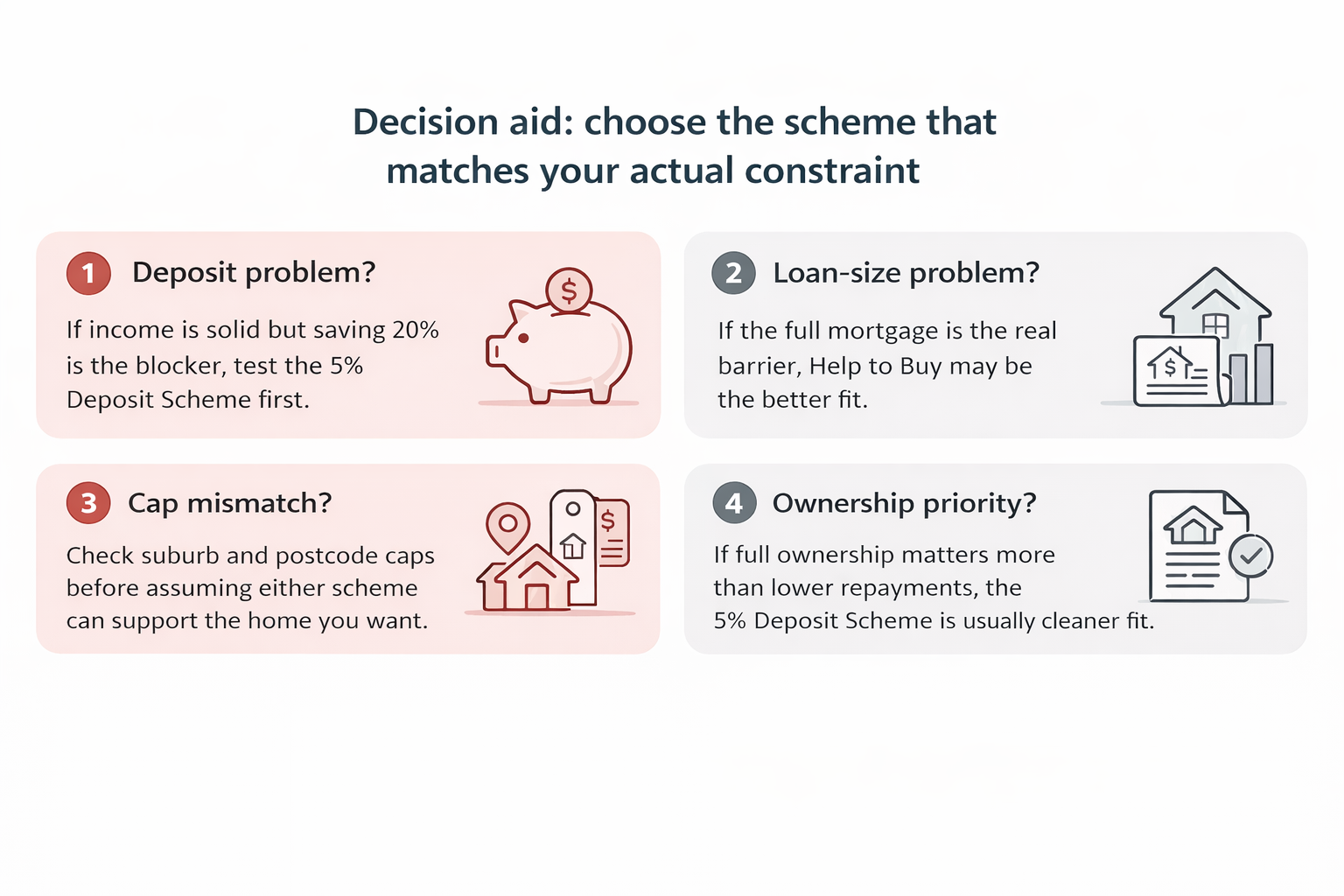
If you are deciding between these pathways, start with four questions.
First, is your real barrier the deposit or the monthly repayment? If it is mostly the deposit, the 5% Deposit Scheme may be enough. If it is mainly the loan size, Help to Buy may be more useful.
Second, what is your income relative to Help to Buy's caps? A buyer above those thresholds may still have access to the 5% Deposit Scheme but not Help to Buy.
Third, what does your target suburb look like against each scheme's price caps? The cap mismatch alone may eliminate one option.
Fourth, how strongly do you value full ownership from day one? If that matters more than reducing the loan size, the 5% Deposit Scheme is usually the cleaner fit.
Mistakes to avoid before applying
One common mistake is treating eligibility as approval. Meeting a scheme's headline rules does not mean a lender will automatically approve the loan amount you want.
Another is focusing only on the minimum deposit. In a market where the average dwelling price is above $1 million nationally, buyers still need to budget for stamp duty where applicable, legal fees, inspections, moving costs and a cash buffer after settlement.
A third mistake is assuming current caps make every suburb realistic. They do not. The official tools are postcode based for a reason. A city-wide cap can sound generous while still excluding the exact pockets a buyer has in mind.
The bottom line
The federal first-home buyer landscape is more usable in 2026 than it was a year earlier, but it is also more nuanced. The Australian Government 5% Deposit Scheme is now broader and easier to access than many buyers realise. Help to Buy adds a genuinely different path by reducing the loan size rather than just the deposit hurdle.
In a market where first-home buyer loan values and dwelling prices have both climbed, that distinction is not academic. It is the difference between a buyer who merely gets to bid sooner and a buyer who can sustainably hold the property after settlement.
The right choice is not the scheme with the loudest headline. It is the one that matches your income, your deposit, your target location and your appetite for either full debt exposure or shared equity.
Are you currently weighing up the 5% Deposit Scheme, Help to Buy, or another path into the market?
We'd love to hear what first-home buyers are seeing in practice - Whether the real challenge is saving the deposit, passing serviceability, finding homes under the caps, or deciding whether shared equity is worth it.
Join the discussion on our community post and share your experience or thoughts.
References & Sources
- Housing Australia, Unlimited places, higher property price caps for first home buyers from 1 October 2025 (24 August 2025)
- Housing Australia, Applications now open for the Australian Government Help to Buy Scheme (5 December 2025)
- Housing Australia, More Australians supported into home ownership with the launch of the Australian Government Help to Buy Scheme (December 2025)
- First Home Buyers, Australian Government 5% Deposit Scheme
- First Home Buyers, Property Price Caps
- First Home Buyers, Australian Government Help to Buy Scheme
- First Home Buyers, Help to Buy Property Price Caps
- ABS, Lending indicators, December Quarter 2025" (11 February 2026)
- ABS, Total Value of Dwellings, December Quarter 2025 (10 March 2026)
- ABS, Consumer Price Index, Australia, December 2025 (28 January 2026):
- RBA, Cash rate target overview
- RBA, Statement by the Monetary Policy Board: Monetary Policy Decision (3 February 2026)


